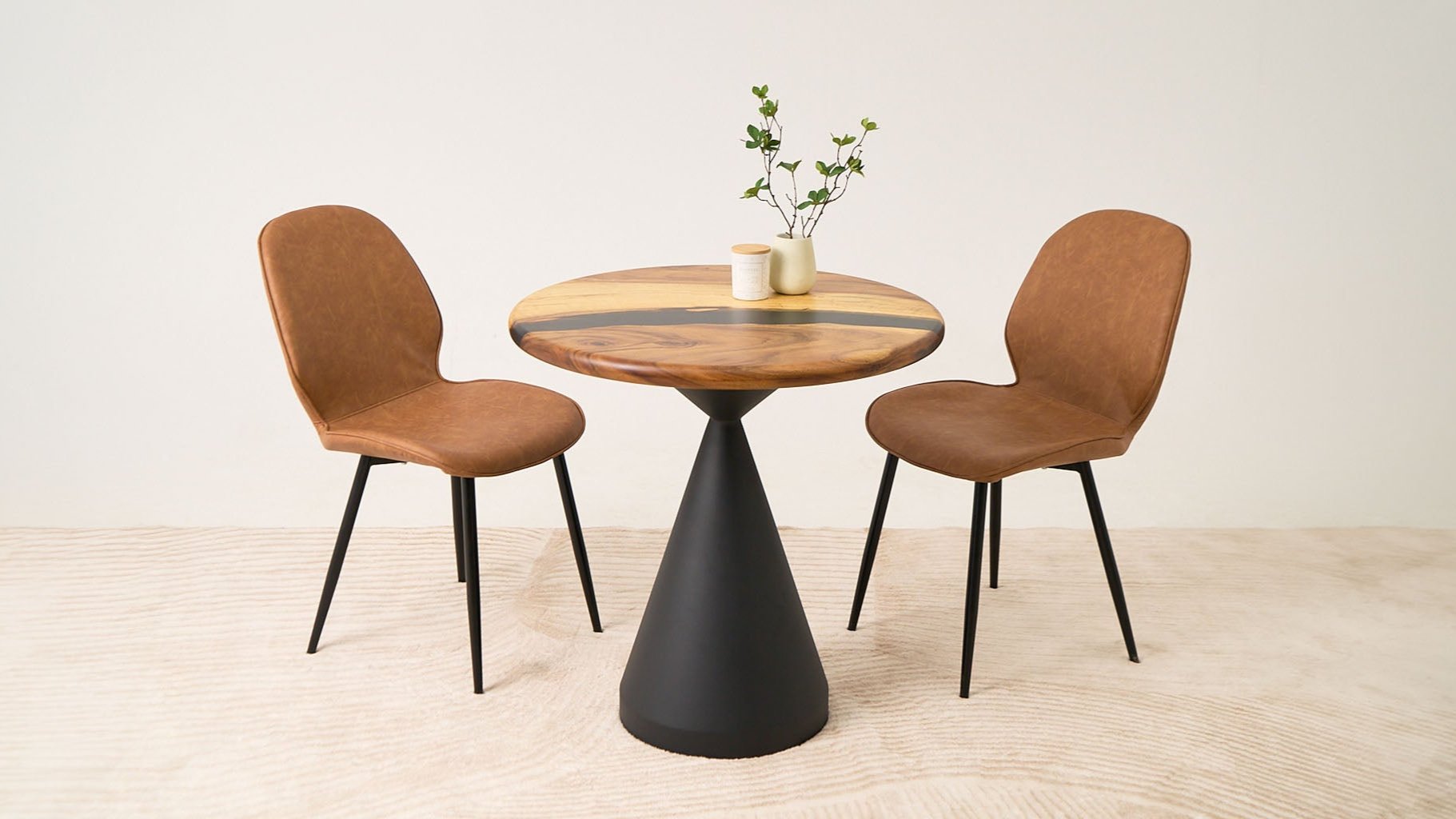

What is MDF table top? It's a question that comes up a lot when people compare budget options to solid wood. Unlike natural wood with its visible grain and knots, MDF looks completely uniform. It's become popular for painted furniture, cabinets, and budget desks because of the smooth finish and lower price.
But before you buy an MDF dining table or desk, you should understand what you're getting. Today, Lumber Grand breaks down: MDF table top meaning, how they're made, where they excel, where they fail, and how to care for them properly. By the end, you'll know exactly if MDF table top durability fits your needs or if you should invest in something more durable. Read more!
What is MDF Table Top?
MDF table top (medium-density fiberboard) is an engineered wood that manufacturers take wood, break it down into tiny fibers, mix it with resin, and then press it all together under heat and pressure. What comes out are flat, smooth sheets that don't resemble the original wood at all.

The MDF wood meaning refers to its density classification
Photo: Materials of the World
Unlike natural wood cut directly from trees, it’s entirely manufactured. Let’s find out “what is mdf table top made of”:
-
Wood fibers: About 80%
-
Urea-formaldehyde resin binder: 10%
-
Water: 8 — 9%
-
Paraffin wax for moisture resistance: 1 — 2%
You won't see grain patterns, knots, or any of the natural quirks that show up in oak or maple.

what is mdf wood made of
Photo: Industry manufacturing specifications
In addition, MDF weighs more than plywood. The density runs between 600 and 800 kg/m³, and that density stays consistent throughout the whole sheet. This consistency makes it useful for some jobs and problematic for others.
The "medium-density" label just means it sits between particle board (lighter) and hardboard (heavier). People buy MDF for table tops, cabinet doors, shelving, and painted furniture because it finishes smoothly. Better yet, an MDF table top costs less than a solid wood one. Water and heavy loads are where it struggles, though.
View more: What is a Table Top?
MDF vs Wood Table Top: Which Material is Right for You?
If you are still curious what to choose between MDF and solid wood, here’s a quick side-by-side to help you figure out what is MDF table top is and what a real wood table top is, and whether they fit in your space:
|
Feature |
MDF Table Top |
Natural Wood Table Top |
|
Price |
40% to 60% cheaper than hardwood |
More expensive due to natural wood cost |
|
Appearance |
Smooth surface, takes paint and veneer well |
Natural grain and texture, unique per piece |
|
Durability |
Moderate, as MDF is sensitive to moisture, it can’t be refinished |
Very durable and can last decades with care |
|
Workability |
Easy to cut and shape |
Needs tools and woodworking skills |
|
Eco-Friendliness |
Made from recycled wood fibers. Yet, it contains synthetic adhesives (may emit VOCs). |
Natural, but might involve deforestation |
|
Best Use |
Indoor furniture, painted cabinets, shelving |
Dining tables, heirloom pieces, high-traffic areas |
In general, an MDF tabletop is perfect for you if you want something budget-friendly, easy to customize, and ideal for painted finishes in dry, indoor spaces.
However, if you're looking for natural beauty, long-term durability, and the ability to refinish over time, solid natural wood is your best bet. Ideally, we specialize in handcrafted live edge table tops and epoxy tables that go beyond what MDF can offer:
-
Better water resistance
-
One-of-a-kind beauty
-
Built to last generations
-
Cover with up to 4 Polyurethane finishes
-
Include C-channels for the epoxy tables above 29 inches

Natural wood gives you natural beauty, long-term durability, and the ability to refinish over time
Credit: Lumber Grand
Shop now: RANDOM RECTANGLE DINING TABLE - Natural Wood Grain
Whether you're furnishing a dining room, office, or outdoor patio, our handcrafted epoxy tables bring together natural wood character and modern durability. Explore Lumber Grand's wood tables and find a table that's as unique as your space.
Either way, we believe that understanding these differences helps you make a smarter choice for your space.
Don’t skip: Best Wood for Table Top
1. Types of MDF Used for Table Tops
The fact is that not all MDF top table are the same. There are several specialized types, each made for different uses.
1.1 Standard MDF
Standard MDF is the basic, general-purpose grade that works for dining tables, desks, and furniture in dry indoor spaces. It usually has a density between 600 and 800 kg/m³ and gives you that smooth surface MDF is known for. But it doesn't handle moisture well, which matters for table surfaces.

What is mdf table top furniture
Photo: Lumber Grand
1.2 Moisture-Resistant (MR) MDF Table Top
This type of table top is made for places with more humidity, like kitchens and bathrooms. It has better moisture-repellent resins and more wax mixed in. You can often spot it by the green color, though the dye itself doesn't do anything for water resistance.
Moisture-resistant MDF is a better pick for dining tables or kitchen surfaces where spills happen. Still, even MR-MDF isn't waterproof and needs proper sealing.
1.3 High-Density MDF Table Top (HDF)
With a density of over 800 kg/m³, HDF is stronger, harder, and holds screws better. That’s why it’s suitable for tables that get heavy use. And since it's heavier than regular MDF, it matters if you move the furniture around.
1.4 MDF Table Top Thickness Considerations
For table tops, thickness matters. Most use MDF sheets between 18 and 25mm. Anything thinner than 15mm doesn't have the strength for table use and will sag under weight. Thicker panels feel more substantial and hold up better, but they also get quite heavy.
Fun fact: When MDF gets wet, it expands to as much as 40% of its original size!
You might like: Best Table Top Epoxy Options
How People Make MDF Table Top
Understanding what MDF table tops are made of and how they're manufactured helps explain why these surfaces perform the way they do. It’s not just simple, like MDF is made of about 82% wood fiber, 9% resin, 8% water, and 1% wax. There is more process behind it. Let’s see!
1. The MDF Table Top Manufacturing Process
-
MDF production starts with raw scraps, usually leftovers from sawmills, such as chips, sawdust, and shavings. Workers strip bark from logs and run them through chippers to break everything into uniform pieces.
-
Steam softens the chips. Then, a machine called a defibrator tears them into individual fibers.
-
This fiber separation makes MDF different from other wood products. The fibers stay mostly intact but get pulled apart from each other.
-
They move through a "blowline" next. Additives get sprayed on here. Paraffin wax goes first for moisture resistance. Resin follows as the binding agent. A heated chamber dries everything until the fibers turn light and fluffy.
-
Workers spread these fibers onto a moving belt in a random pattern. This randomness explains why MDF has no grain. It performs the same in every direction, unlike real wood.
-
The fiber mat gets compressed slightly. Then, it moves into a hot press. High heat and pressure activate the resin and fuse everything into a solid panel. The panels cool down next. Sanding follows to create that smooth surface MDF is known for.
-
Workers cut the big panels down to standard sizes. For furniture, most MDF sheets run 18mm to 25mm thick. The exact thickness depends on what the piece needs to support.

The MDF Table Top manufacturing process
Photo: Daiken
2. Common Finishes for MDF Tables
Raw MDF rarely gets used as is for table surfaces. How well an MDF table top works depends a lot on what finish goes on it:
-
Paint is the most common. MDF's smooth surface takes paint really well, and you can get a flawless look that's impossible with wood grain showing through.
-
Wood veneer is a thin layer of real wood, usually 1 to 2mm, that makes it look like solid hardwood while keeping MDF's stability and lower price.
-
Laminate is a durable plastic coating that handles moisture and scratches better. You see this a lot on budget dining tables.
-
Melamine coating is resin-treated paper that gives decent protection and comes in different colors and patterns.
What is MDF Table Top Used For? Best and Poor Applications
Given these characteristics, when should you choose an MDF table top? Let’s take a look!
1. Good Applications for MDF Tables
-
MDF desk top for home offices works well in controlled indoor spaces. The smooth painted surface is easy to clean and gives you a modern look without spending much. As long as you're careful with drink spills, MDF desks can last for years.
-
Craft and hobby tables benefit from MDF's smooth surface that won't snag things. The price also means you're less worried about cutting into it or getting paint and glue everywhere.
-
Display tables for retail or trade shows work well with MDF. It's lighter than solid wood, has a smooth finish, and doesn't cost much. These setups rarely get exposed to moisture anyway.
-
Coffee tables can work with MDF. If you go with a moisture-resistant grade and seal your MDF coffee table completely with multiple coats of finish. You'll need to use coasters religiously, though.
-
Children's activity tables work nicely with the smooth, easy-to-clean painted surface. The lower cost also makes the inevitable damage less painful.
-
Budget office furniture often uses MDF. For workplaces where appearance matters but money is tight, painted MDF does the job.

People buy MDF for table tops, cabinet doors, shelving, and painted furniture
Photo: Freepik
2. Poor Applications for MDF Tables
-
Kitchen or dining tables are risky unless you use MR-MDF with really good sealing and wipe up every spill immediately. Even then, the edges stay vulnerable. For families with kids or people who entertain a lot, the moisture risk probably isn't worth the savings.
-
Outdoor patio tables are a flat no for MDF of any grade. The material can't handle the weather.
-
Bathroom vanities deal with constant humidity and water splashes. Not MDF's strong suit, even the moisture-resistant kind.
-
Heavy-duty workbenches need the strength and toughness that solid wood or plywood provides. MDF doesn't hold up in workshop settings with heavy tools and materials getting dropped on it.
-
Heirloom furniture meant to last for generations should be solid wood that you can refinish over and over. MDF has a limited lifespan.
Pros and Cons of MDF Table Tops
Here's an honest look at MDF dining table pros and cons. Like any material, MDF shines in certain situations and falls short in others.
|
Pros |
Cons |
|
|
1. Advantages of MDF Table Tops
Despite some real limitations we'll talk about in a bit, MDF furniture has genuine advantages that explain why it's so popular.
-
Budget-friendly: MDF tables cost quite a bit less than solid hardwood. For a painted MDF desk or dining table, you'll usually pay 40 to 60% less than similar solid wood furniture.
-
Aesthetic advantages: When it's finished well, an MDF dining table can look convincingly like expensive hardwood. Good quality wood veneer over an MDF core gives you the appearance of solid wood with better stability and a lower price.
-
Structural benefits: MDF table tops stay dimensionally stable. They won't warp, twist, or cup like solid wood does when humidity changes.
-
Workability: MDF is easy to work with. It cuts cleanly with standard woodworking tools, routs nicely for decorative edges, and works well with joinery techniques. The smooth surface needs less prep before finishing compared to natural wood, which requires more prep.
-
Eco-friendly (in some ways): MDF is made from recycled wood fibers and sawdust that would otherwise go to waste. That’s why MDF gives it some environmental benefits compared to cutting down whole trees.
Latest blog: Best Polyurethane for Table Top
2. Disadvantages of MDF Table Tops
Before you commit to this material, it’s essential to understand the drawbacks of MDF table tops.
-
No natural beauty: MDF table top has NO wood grain, character, or natural warmth.
-
Weight issues: A standard MDF dining table weighs 30 to 50% more than a similar plywood or solid wood table. Moving it becomes a chore. You need beefier supports and reinforced leg attachments to handle the extra pounds.
-
Moisture vulnerability: Water ruins regular MDF. The material swells and softens until it falls apart completely. Edges go first since they're the most exposed. Once water gets in, the damage is permanent.
-
Impact resistance: MDF dents pretty easily compared to hardwood. A dropped plate or bumped chair leaves marks that don't come out.
-
Surface damage: Scratches that go through the finish expose the porous core underneath, which then becomes vulnerable to moisture.
-
Repairability: Unlike solid wood, which you can sand and refinish over and over, MDF can't be repaired once it's damaged.
-
Structural strength: MDF isn't as strong as plywood or solid wood across longer spans. Bigger tables need extra support in the middle, or they'll sag over time.
-
Edge weakness: Screws pull out of MDF edges pretty easily. The material just crumbles around the threads or strips out, so connections get wobbly and eventually fail.
-
Contains Formaldehyde and VOCs: Standard MDF is made with formaldehyde-based adhesives, which can off-gas volatile organic compounds (VOCs) into your home.
-
Health and maintenance considerations: Cutting or sanding MDF creates very fine dust that can be bad for your lungs.
-
Not suitable for outdoor use: Some studies show MDF absorbs water 60% faster than solid wood. Thus, it can’t be used outdoors.
-
Shorter lifespan: MDF furniture typically lasts only a few years with normal use.

What are MDF table top pros and cons
Photo: Inside Out Contracts
Note: Modern MDF has to meet formaldehyde emission standards (E1 or better in most places), so finished MDF furniture is generally safe. But you can't refinish it like solid wood, which limits its lifespan.
MDF Table Tops Environmental & Health Considerations
Next section, let’s find out the broader impacts of MDF furniture to help you make better decisions.
1. Formaldehyde in MDF
The urea-formaldehyde resin used to bind MDF releases small amounts of formaldehyde gas over time. This used to be a bigger concern, but regulations have gotten much stricter.
As mentioned earlier, all MDF legally sold for indoor use in major markets now has to meet E1 emission standards (0.1 ppm formaldehyde or less). At this level, properly finished MDF furniture in everyday use poses minimal health risk for most people.

MDF contains formaldehyde, a chemical used in the resin that binds wood particles together
Photo: Chemicals
Lower emission options exist if you're particularly concerned:
-
E0 grade (≤0.07 ppm)
-
CARB Phase 2 compliant
-
NAF (No Added Formaldehyde) using alternative resins like pMDI
Sealing all MDF surfaces properly with primers, paints, laminates, or veneers significantly cuts down any emissions from the core material.
2. Sustainability Factors
In fact, MDF has some environmental upsides. It uses wood that would otherwise go to waste. Most of the raw material comes from sawmill leftovers like chips, sawdust, and shavings. Also, MDF can incorporate recycled wood and works well with fast-growing plantation trees.
Secondly, MDF stores carbon that was absorbed when the trees grew. That carbon stays locked away as long as the furniture is around.
That said, making MDF takes a lot of energy and depends on synthetic resins. There aren't many recycling options, so most MDF furniture ends up in landfills, though new technologies to recover and reuse the fibers are starting to appear.
Therefore, we recommend looking for FSC or PEFC certified products to make sure the wood fibers come from responsibly managed forests.
MDF Table Top Buying Guide: What to Look For
If you have made up your mind to go with MDF table top, then you must know how to select the right one.
1. Quality Indicators
-
Check the finish carefully: One way is to run your hand over the MDF surface. It’s only good when you feel smooth and even with no rough areas, bumps, or thin coverage. Besides, taking a look at the paint from different angles under proper lighting will help you detect any imperfections.
-
Examine the edges: This is the place where retailers tend to cut costs. Edges should be sealed, painted, or banded, never raw MDF. Now trace your fingers along them once more. Do they feel as smooth as the top? Unfinished edges are likely to absorb moisture very fast and thus, start breaking down.
-
Double-check the thickness: MDF table tops need at least 18 to 20mm to hold up properly. Thinner MDF doesn't have the strength for table use. If possible, measure it yourself rather than relying on product descriptions.
-
Ask about the MDF grade: Standard or moisture-resistant? Suppose it's going in a dining room or kitchen, you’d better spring for MR-MDF. The extra cost pays off.
-
Check the manufacturer's reputation: Established furniture brands with warranties are safer bets than unknown companies selling low MDF prices.
2. Questions to Ask MDF Table Top Sellers
-
What type of MDF is this? Standard, moisture-resistant, or something else?
-
What is MDF table top thickness?
-
What finish did you apply, and how many coats?
-
Are the edges sealed properly?
-
What's the weight capacity?
-
Does it meet formaldehyde emission standards? E1 or better?
-
What kind of warranty comes with it?
3. Red Flags to Avoid
-
Raw, unsealed edges are one of the major indicators of bad quality. It implies that the producer skipped protecting the most vulnerable part from moisture damage.
-
Price tags that appear too attractive often mean thin MDF (under 15mm), sloppy finishing, or missing steps like proper edge sealing.
-
Vague or missing details about materials and construction suggest the seller doesn't want you looking too closely.
-
Any edge swelling or damage on showroom pieces indicates either water exposure or poor manufacturing. In either case, it’s advisable not to buy.
How to Care for MDF Table Tops
So, if you do choose an MDF dining table or desk, taking care of it properly matters for how long it'll last.
-
Wipe spills immediately
-
Use a coaster for your glass or cup, not the bare MDF table top.
-
Use placemats under dishes to protect from heat and moisture. H
-
Don't use a soaking wet cloth or spray cleaners right onto the surface.
-
If you're buying furniture, it’s advised to check the edges carefully. Raw, unsealed edges are a warning sign that the piece won't hold up.
-
Proper sealing is absolutely critical for how long your table lasts. All MDF table tops, especially edges, should have multiple coats of protective finish.
-
For MDF dining tables that get regular use, consider using a tablecloth or putting a glass top over the surface for extra protection.
-
Use furniture pads under decorative objects to prevent scratches and let air circulate under items that might trap moisture.
-
Don't let water or moisture sit on the MDF tabletop.
-
Skip harsh chemical cleaners that might damage the finish.
-
Keep MDF furniture away from really humid places.
-
Direct sunlight over time can fade finishes, especially painted surfaces.
FAQs
1. Is MDF Good for a Dining Table?
No, MDF is not a good choice for dining tables. We do agree that it's an affordable option, but MDF has significant drawbacks that make it poorly suited for the daily wear and tear a dining table experiences.
2. Is MDF Better than Plywood?
Not really, MDF is better than plywood or not, it depends on what you're building.
MDF is better when:
-
You want a perfectly smooth surface for painting
-
You need consistent thickness with no voids or knots
-
You're doing detailed cuts or decorative edges
-
Budget is a priority
Plywood is better when:
-
You need moisture resistance (kitchens, bathrooms)
-
The piece will hold a heavyweight or structural load
-
You're building something that needs flexibility without breaking
-
You want to stain or show wood grain (plywood has visible layers)
3. Is MDF Toxic to Humans?
Yes, MDF can be hazardous if you're cutting or sanding it yourself. The fine dust contains formaldehyde, a respiratory irritant and known carcinogen. DIY woodworkers working with MDF at home face real health risks without proper dust extraction and respirators (not just basic dust masks).
Conversely, for finished furniture that's already sealed or painted, MDF is generally safe. But if you're considering a DIY table project, we'd honestly recommend working with natural wood instead. It's safer to work with and creates a healthier home environment.
What is MDF Table Top: Guide Ends Here
At the end of the day, MDF has its place. Painted indoor furniture, budget home offices, craft tables, and temporary pieces where you care more about price than how long it lasts. It's not bad material. Just needs to be used appropriately.
Yet, if you’re planning for MDF dining tables meant to last decades, MDF doesn't cut it. Solid wood desk table tops and dining tables are what you need there.
Besides, if you need help choosing the perfect table, please don't hesitate to contact us. Our Support team is ready to guide you anytime. And, if you found this guide helpful, explore our blogs for more insights on what is MDF table top and other furniture materials. Thank you for reading!