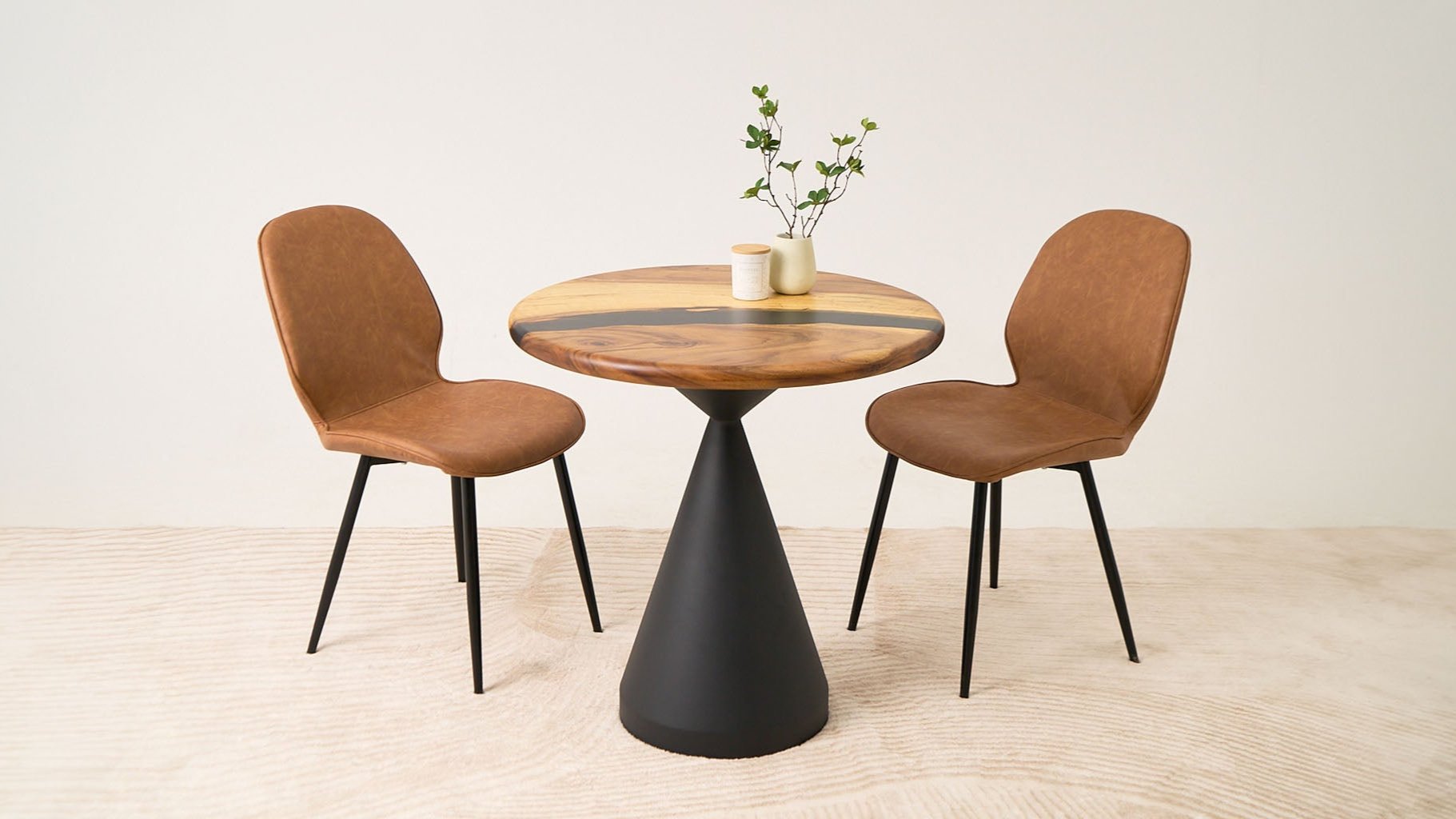

You can often solvehow to fix a wobbly table without a single tool, because a simple quarter turn of the table is mathematically proven to work on an uneven floor.
Of course, not every wobble is that easy. Some tables rock because of the floor, while others sway because a joint has worked itself loose. The fix is completely different for each one, and that’s why stuffing napkins under a leg never lasts.
In this guide, our team at Lumber Grand walks you through every wobbly table fix we use in our shop, starting with 30-second tricks and moving up to permanent repairs.
First, let's figure out which type of wobble you actually have.
Wobbly Table Meaning: Which Wobble Do You Have?
The wobbly table meaning is any table that rocks, shakes, or sways when you touch it. However, there are 2 very different types of wobbles, and diagnosing yours takes about 30 seconds.
The 30-second wobble test:
1. Place both hands on the tabletop and rock it gently, corner to corner. If it clunks back and forth like a seesaw, one leg is not touching the floor. That means your problem is the floor or a short leg.
2. Now push the top gently from the side. If the whole table wobbles side to side while all four feet stay planted, your problem is loose joints or failing hardware. Woodworkers call this movement "racking."
This distinction matters because rotating the table or adding a shim only cures the first type. If your table wobbles side to side, skip ahead to the joint and bracing fixes below, because no shim on earth will stop that sway.
Why Are My Table Legs Wobbly? 6 Common Causes
So, why are my table legs wobbly in the first place? In our experience repairing and building tables, the cause is almost always one of these six.
-
Loose hardware: Every time you pull table out to vacuum underneath or slide it over for a party, those screws and bolts get a little workout. After months or years of this, they start getting loose.
-
An uneven floor: Most floors hide small dips and high spots you cannot see. When one leg lands on a low spot, the table rocks even though nothing is broken
-
Uneven leg length: Sometimes one leg was cut slightly short at the factory, or years of wear have ground it down more than the others.
-
Worn-out joints: The joints where wobbly table legs meet the tabletop or apron carry the load of every dinner, homework session, and elbow lean. Eventually, the glue lets go, or the wood around the joint compresses.
-
Failed brackets and plate: Metal brackets, hanger bolts, and mounting plates can bend, strip, or crack, which leaves the leg barely hanging on.
-
Missing bracing: Tables with thin legs and no diagonal support tend to warp over time. As one woodworker put it, diagonal bracing "prevents a rectangle from becoming a parallelogram," and that single sentence explains most side-to-side wobbles.
You might like: How to Brace a Table Top
How to Fix a Wobbly Table in Under a Minute: 3 Quick Fixes
If your table rocks corner to corner, start here. These three tricks show you how to stop a table from wobbling in less time than it takes to set the dinner table. None of them requires tools.
1. The Quarter-Turn Method (Proven by Real Math)
This quarter-turn method sounds like an old handyman's tale, but mathematicians have actually proven it. Rotate a four-legged table around its center, and somewhere within a quarter turn, all four legs will find solid ground.
As you rotate the table, the gap under the hovering leg gradually shrinks, closes, and would then reverse. Because that change happens smoothly, there must be a point during the turn where all four legs touch at once.
Mathematicians call this the intermediate value theorem, and researchers at Monash University published a formal proof, which Scientific American covered in detail. Their math shows the trick works even on floors that slope locally up to about 90 degrees (a quarter turn), as long as your table legs are equal in length.

Using the quarter-turn method to fix a wobbly table
Photo: Numberphile
Here's how to fix a wobbly table with a quarter-turn:
-
Clear the table surface completely to make rotation easier and safer
-
Mark the starting position by placing a piece of tape on both the table edge and the floor so you can track your progress
-
Lift one side slightly and rotate the entire table 90 degrees clockwise
-
Test for stability by gently pressing down on each corner of the table
-
Continue rotating in quarter turns if wobbling persists, and try all four positions (0°, 90°, 180°, 270°)
-
Adjust the position by making small adjustments (15 — 30 degrees) around the most stable quarter-turn position
To be honest, the table will be stable but NOT always perfectly level, so a round rolling object like a pen may still drift. Moreover, this trick only fixes floor-caused rocking. It does nothing for loose joints.
2. Slide a Shim Under the Short Leg
Now, how to fix a wobbly table in just a few seconds? Let’s grab whatever's handy, such as:
-
A coaster
-
Fold up a napkin a few times
-
Old matchbook
-
Even tear off a piece of cardboard

How to fix a wobbly table with makeshift shims
Photo: Alamy
You slip it under whichever leg isn't touching the ground properly. Sure, it's not going to win any design awards, but it'll give you an instant fix for a wobbly table that actually works.
3. Wine Cork Trick
With this hack, we'll take a wine cork and slice off a disc that's about the right thickness to level out your table. You can make it thicker or thinner depending on how much lift you need. Once you've got the right size, simply dab a little hot glue on it and stick it under the short leg.

Wine cork hack gives you a great excuse to open a bottle of wine for "research purposes."
Photo: Freepik
6 Permanent Ways to Fix a Wobbly Table
You don't have to ask yourself anymore about how to fix wobbly legs on a table, since we’ll provide you with the 9 best ways to fix it right away.
1. Tighten Every Screw and Bolt
You might be surprised that the solution is as simple as tightening a few screws that have worked themselves loose over time. This is the first case in learning how to fix a table that wobbles:
-
Step 1: Locate the mounting plate that connects the pedestal to the tabletop
-
Step 2: Tighten each screw until it's flush with the mounting plate (please don’t over-tighten)
-
Step 3: Check and tighten any visible leg screws or bolts
-
Step 4: If screws feel loose in their holes, you need to remove them, apply wood glue to the holes, and then immediately reinstall the screws.

Tighten each loose screw until it's flush with the mounting plate (avoid over-tightening)
Photo: Freepik
2. Fix Stripped Screw Holes with the Toothpick Trick
Sometimes a screw spins in place and never gets tight. That means the hole is stripped, and simply squirting glue in there will not hold. Instead, we use the repair trick that carpenters have relied on for generations.
- Step 1: Remove the screw completely.
- Step 2: Dip a few wooden toothpicks in wood glue and pack them into the hole. Withthose larger holes, you need to glue in a piece of hardwood dowel instead.
- Step 3: Let the glue cure fully, then trim the excess flush.
-
Step 4: Drive the screw back in. It now bites into fresh wood and grips like new.
3. Re-Glue and Clamp Weak Joints
When a wooden joint feels loose, and you can see a gap where the leg meets the apron or top, glue is what we reach for.
- Step 1: Work wood glue deep into the gap. A flat toothpick or a syringe helps push it in.
- Step 2: Clamp the joint tight and wipe away the squeeze-out with a damp cloth.
-
Step 3: Leave the clamps on overnight. Glue that cures under pressure bonds far stronger than glue left loose.
4. Install a Table Stabilizer Bar
When you're tired of messing around with temporary solutions and want something that really works, a table stabilizer bar is the heavy-duty answer. We suggest this method for larger tables or those with pedestal bases.
Here's how to fix a wobbly table with a stabilizer bar:
- Step 1: You mount this adjustable bar between two opposite legs, kind of like a tension rod but much sturdier.
-
Step 2: Adjust the tensioner until the wobble stops completely
5. Level the Legs: Adjust, Trim, or Extend
Next, if one leg truly is a different length, you have 3 options. Before you touch a saw, test the table on a known flat surface first, such as a garage slab or sheet of plywood. If the wobble disappears there, your floor is the problem, not the leg, and cutting would ruin the table for every other room.
- Option A. Add adjustable leveling feet: Drill a pilot hole in each leg bottom, tap in a threaded insert, and screw in the levelers. Then twist each foot until the table sits rock solid. Honestly, we wish every table shipped with these. That is why our quality tables include built-in adjustable levelers.

Adjustable table legs can save you from wobble problems forever
Credit: Lumber Grand
Shop now: Coffee Table for Minimalist Interiors, Handcrafted Unique Design - Flux Base
- Option B. Trim the long leg: Shim the three shorter legs until the top sits level, measure the gap thickness, and mark that amount on the long leg. Cut carefully with a fine saw, then sand the end smooth. Remove less than you think, because you can always cut more.
-
Option C. Extend the short leg: Drill a pilot hole into the bottom of the short leg and thread in a lag bolt, leaving it proud by the gap distance. Turn the bolt in or out to fine-tune the height, then cap it with a felt pad to protect your floor.
5. Upgrade to Self-Adjusting Levelers
Maybe your table gets moved around a lot, or you're running a busy restaurant where nobody has time to crawl under tables adjusting feet all day. In such cases, we can use self-leveling table feet (automatic levelers) instead.
These clever little devices use springs, gravity, or hydraulic pressure to adjust when weight is put on the table automatically.
-
If someone sits down and leans on one side, the levelers instantly compensate to keep everything stable.
-
Or if you move the table to a different spot with a slightly uneven floor, the legs adapt on their own.
6. Add Diagonal Bracing to Stop Side-to-Side Wobble
Do you remember the racking test from earlier? If your table sways sideways, it is missing triangles. A rectangle can lean into a parallelogram, but a triangle cannot change its angles. Therefore, adding any diagonal element locks the frame solid.
- Step 1: Screw metal L-brackets into the inner corners where each leg meets the apron or tabletop.
- Step 2: With a stronger fix, cut wooden corner blocks at 45 degrees and glue and screw them across each corner.
- Step 3: On trestle or X-frame tables, run a brace from the leg intersection up to the center of the tabletop.
Nobody sees any of this hardware once the table is upright. For a full walkthrough with photos, read our guide on how to brace a table top.
How to Fix a Wobbly Table by Type: 5 Special Cases
Different tables wobble in different ways. So here is how we approach the most common special cases in the shop.
1. How to Fix a Wobbly Metal Table Leg
Wondering how to fix a wobbly metal table leg? Metal legs, including hairpin and box-steel styles, almost never bend on their own. Instead, the bolts holding the top plate work loose.
-
Step 1: Flip the table and tighten every bolt on the leg plates with a hex key or socket wrench.
-
Step 2: If a bolt keeps loosening, add a lock washer or a drop of removable threadlocker.
-
Step 3: Check that the threaded inserts in the tabletop have not pulled out. If one spins, re-set it with epoxy.
-
Step 4: For thin hairpin legs that flex sideways, add a small corner brace or upgrade to a thicker gauge leg.
2. How to Fix a Wobbly Coffee Table
Learning how to fix a wobbly coffee table follows the same playbook. It’s just at knee height. Coffee tables take a beating from feet on the top, kids leaning on corners, and constant sliding across the rug.
Because of that, their small screws and slim legs loosen faster than dining tables. Tighten the leg hardware first, then check the corner blocks under the top, and re-glue any loose ones.
Afterward, if the table still rocks on your rug, remember that thick carpet itself can cause the wobble. Thus, don’t forget to test it on hard flooring before you adjust anything. Once it sits steady, you may enjoy our guide on how to style a coffee table.
3. How to Fix a Wobbly Round Table Top
Here is how to fix a wobbly round table top on a pedestal base, which is its own special problem. The top connects to the column through a single mounting plate. Hence, every bit of play multiplies at the table edge.
-
Step 1: Reach under the top and tighten the screws on the mounting plate.
-
Step 2: Check where the column meets the feet, because pedestal bases usually have a large nut or threaded rod there that loosens over time.
-
Step 3: If the top itself flexes, the plate is too small for the diameter. Add a larger plate or a pair of wooden support cleats across the underside.
-
Step 4: For stubborn cases, a table stabilizer bar designed for pedestals stiffens the whole column.
4. How to Fix Wobbly Antique Table Joints
Fixing a wobbly antique table requires special care because it may be old, easily breakable, or valuable. Don’t jump right into screw or drilling since it may harm the table.
Here's the careful approach for antique table repairs:
-
Step 1: You should try reversible fixes first, like adjustable feet, rubber pads, or shims that can be removed without leaving marks.
-
Step 2: We don’t cut, drill, or glue anything that can't be undone later. This is because permanent changes can slash the table's value.
-
Step 3: Call a professional furniture restorer for valuable pieces
-
Step 4: Use traditional methods like hide glue instead of modern wood glue if any joint work is needed
-
Step 5: Take photos and keep notes of any repairs for documentation, as future owners will want to know the table's history

When dealing with valuable furniture, knowing how to fix a wobbly antique table requires extra care
Photo: Freepik
5. How to Fix a Wobbly Folding Table
Folding tables add hinges and locks to the equation, so check the folding parts before you blame the legs. Press each locking mechanism to confirm it snaps fully into place, then tighten every bolt on the hinges and braces. Replace any worn locking pins or springs.
Finally, if the mechanism itself is bent, a replacement leg assembly costs little and bolts straight on.
FAQ
1. Why Is My Table Wobbly After Putting It Together?
Nine times out of ten, flat-pack wobble comes from fasteners that were never fully tightened, or from tightening them in the wrong order. Loosen everything slightly, set the table upright on a flat floor, square it up, and then tighten all the bolts gradually in a criss-cross pattern.
This lets the frame settle square before you lock it. Also, you should check that cam locks are turned fully to the closed position, because a half-turned cam is the number one cause of wobbly flat-pack furniture.
2. How to Fix a Wobbly Standing Table?
Standing tables wobble for the same reasons as regular tables, but the height makes the movement more noticeable. Here is how to fix a wooby standing table:
-
Step 1: Tighten all bolts and screws at the base and where the legs attach.
-
Step 2: Check if the base is sitting flat on the floor. Then you can use adjustable feet if needed.
-
Step 3 (optional): For pedestal-style standing tables, a stabilizer bar works wonders.
-
Step 4 (optional): If you own a folding standing table, you’ll need to inspect all the locking mechanisms and hinges for wear.
3. How to Shim a Wobbly Table?
To shim a woobly table, we rock the table to find the leg that lifts off the floor. Then fold a piece of cardboard or cut a slice of wine cork slightly thicker than the gap, and slide it under that leg while pressing down on the opposite corner. Test and trim until the rocking stops.
With a cleaner look, buy tapered plastic shims from the hardware store, push one in until snug, and cut off the part that shows.
4. What Can I Use to Balance My Table Legs?
You have plenty of options to balance your table legs, depending on how permanent you want the fix to be:
-
Folded cardboard, a matchbook, or a coaster for an instant fix
-
Cork discs or stick-on rubber pads for a tidier semi-permanent fix
-
Stackable felt pads for small height differences
-
Screw-in adjustable leveling feet for a permanent, fine-tunable fix
-
An anti-slip mat under the whole table for floors with many small dips

How to fix wobbly legs on a table with felt furniture pad
Photo: Freepik
How to Fix a Wobbly Table: Guide Ends Here
So, we’ve gone through many proven effective ways to fix a wobbly table. Most of the time, it's just a matter of finding the right simple solution, such as:
-
Try the quarter-turn wobbly table theorem trick by spinning your table to find a better spot on your floor
-
Tighten loose screws that have worked themselves free over the years
-
Slip a rubber pad or folded napkin under the short leg
-
Check if anything just needs a good push back into place
-
Etc
Sometimes, though, a table is simply too far gone. If you have tried everything and it still shakes, it might be time to start fresh. Take a look at our solid dining tables, which we build with stability in mind from the first cut, or message our furniture folks for advice. We love helping people find tables that make mealtime pleasant again.
With these proven methods, you'll never have to wonder how to fix a wobbly table again. For more furniture care tips, don’t forget to check out our other helpful guides on maintaining your dining room furniture. Thank you for reading!