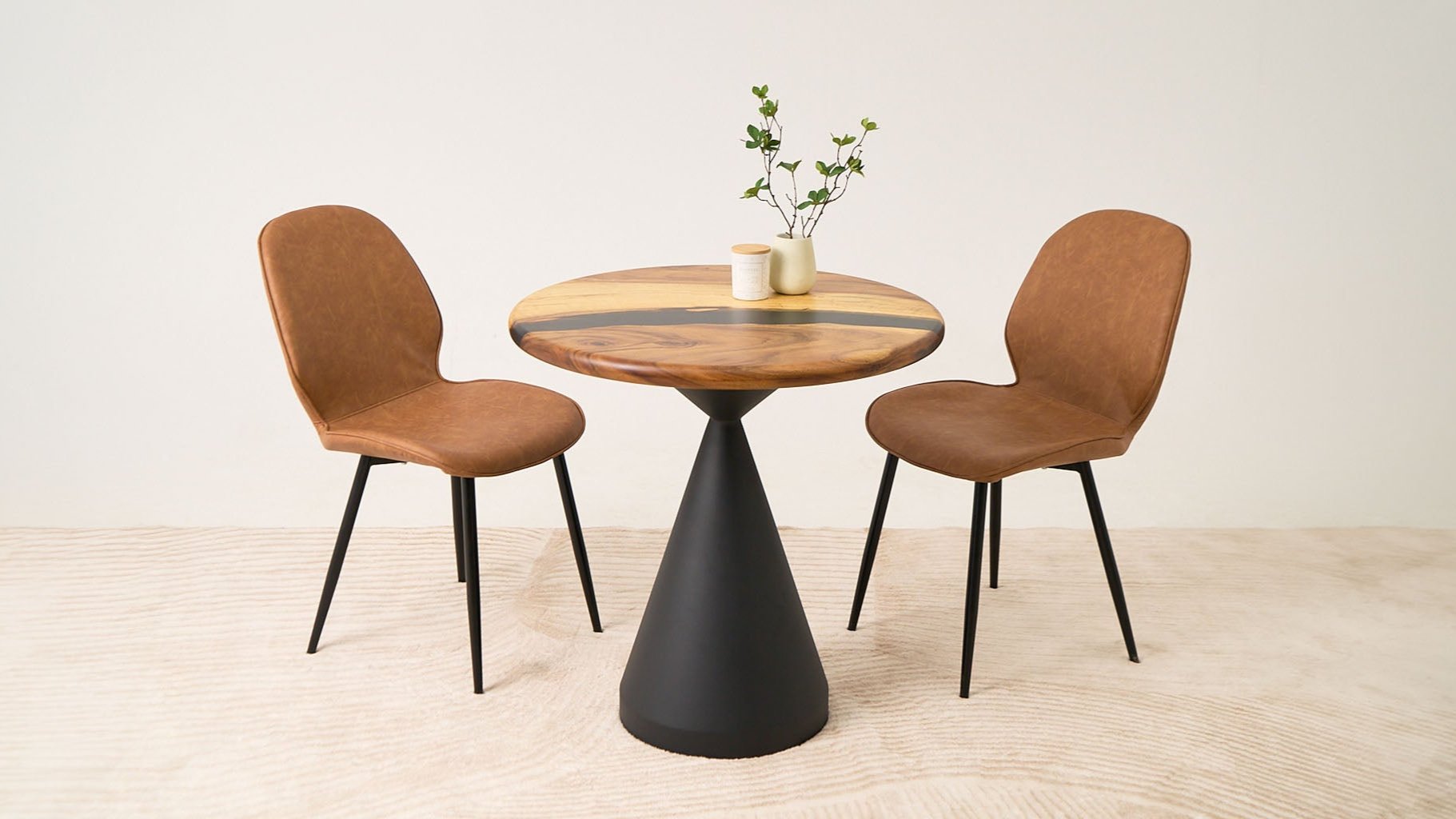

When were benches invented? Nobody invented the bench on a particular day, and no single person gets the credit. People built long shared seats out of stone, logs, and packed earth before they ever built chairs, and the oldest surviving examples date back more than 5,000 years.
What we can trace is how the bench moved from Stone Age homes into Roman forums, medieval halls, Victorian parks, and eventually into cars and gyms. That's the story our team wants to walk you through here, with real dates wherever the record gives us one.
The Bench’s History Timeline at a Glance
If you only need the headline facts about benches, here they are. We'll expand on each one below.
-
c. 3180–2500 BC: Stone-built beds and seating at Skara Brae, Orkney, Scotland, the oldest surviving built-in furniture in Europe.
-
c. 2600 BC: Queen Hetepheres I's gilded armchair and bed in Egypt, found in 1925, and still the oldest complete chair we have.
-
c. 400 BC–200 AD: Greek and Roman exedrae, curved stone benches in sanctuaries, gymnasia, and forums.
-
c. 50 AD: The first clearly recorded workbench, shown in Roman art from Pompeii.
-
13th century: Backless stone benches appear along the walls of English churches, the first church seating.
-
1300: The word “bench” first means “the seat where judges sit” in English.
-
1709 / 1840s: Coalbrookdale Company forms in Shropshire, then switches to cast-iron garden furniture in the 1840s.
-
1844: Janes, Beebe & Co opens in New York and produces some of the earliest American cast-iron park benches.
-
1939: The World's Fair bench debuts, now the signature seat of Central Park.
-
2013: The Chevrolet Impala becomes the last American car sold with a front bench seat.
What is a Bench, Exactly?
A bench is a long seat built for more than one person, usually without a back and often without arms. That "more than one person" part is the whole point. A stool seats one, a chair seats one with status attached, but a bench seats a household, a congregation, or a crowd.
The word itself is old. Bench comes from the Old English benc, which grew out of the Proto-Germanic root bankon, and you can still hear its cousins in the Danish bænk and Dutch bank. Etymologists think the original idea was a man-made earthwork you could sit on, which tells you something about how basic the first benches were.

What is a bench?
Photo: Magnific
Interestingly, the same root gave us the financial "bank," because Italian moneylenders did business over a bench (banca) in the marketplace.
And, if you've ever wondered whether it's "banch or bench," the answer is bench. The word “banch” is simply a common misspelling that Google quietly corrects.
By around 1300, the English word also meant the seat where judges sat, which is why we still talk about "the bench" in court and why England had a Court of King's Bench. Woodworkers borrowed the word, too, so a "workbench" is a bench you work on rather than sit on.

A workbench is a bench you work on rather than sit on
Photo: Magnific
Related blog: 12+ Types of Indoor Benches: Styles, Sizes & Best Wood
The Prehistoric Bench: Before Chairs Existed
Long before anyone carved a chair, people built benches into the walls of their homes. The clearest evidence comes from Skara Brae in Orkney, Scotland. A storm stripped the sand off the site in 1850, and underneath it, archaeologists found a Neolithic village occupied from roughly 3180 BC to 2500 BC.

Stone-built benches at Orkney, Scotland, the oldest surviving built-in furniture in Europe
Photo: Orkney
Every house followed the same layout. A central hearth, stone beds on either side, and a stone dresser facing the door. Those stone "beds" doubled as seating, and they're the oldest built-in furniture we have anywhere in Europe.
Go further back and further east, and you reach Çatalhöyük in modern Turkey, a town of mud-brick houses that people lived in from around 7400 BC. Its homes had raised platforms along the walls for sitting and sleeping, and a famous clay figurine of a seated woman from around 6000 BC proves that seating furniture already existed.
 Who made the first bench
Photo: Wikipedia
So, when someone asks who made the first bench, the honest answer is that farming villagers made them out of clay and stone eight or nine thousand years ago, and they didn't leave their names.
Ancient Egypt: The Oldest Chair Sits Beside the First Benches
Egypt gives us something rare: dated, surviving furniture. On 9 March 1925, while expedition leader George Reisner was away in the United States, his team's photographer noticed a patch of plaster in the Giza plateau where he expected limestone.
Underneath lay tomb G 7000X, the burial of Queen Hetepheres I, mother of King Khufu, who built the Great Pyramid. She lived around 2600 BC.
Her tomb held a gilded armchair, a bed, a canopy frame, and a carrying chair, and the originals now sit in the Egyptian Museum in Cairo, with replicas in Boston's Museum of Fine Arts. That armchair is the oldest complete chair in existence.
Here's the interesting part for bench history. Chairs in Egypt belonged to royalty and priests. Evidence of them goes back to the 2nd Dynasty, around 2785 BC, but ordinary Egyptians sat on stools, mats, and low benches. Temple courtyards and gardens included permanent stone seats, which count among the earliest formal benches on record.
In other words, the bench was the people's seat from the very beginning, and the chair was the exception.
Greece and Rome: The Exedra Turns the Bench Into Public Furniture
The Greeks gave the bench a name and a civic role. An exedra literally means "a seat out of doors," and it describes a room or recess fitted with a curved, high-backed stone bench. Free-standing exedrae became a signature of Hellenistic sanctuaries such as Delos and Epidaurus, where they lined sacred routes so pilgrims could rest and talk.

An exedra literally means "a seat out of doors."
Photo: World History
The Romans then ran with the idea. They placed exedrae in gymnasia for philosophical debate, in forums for public gatherings, and in basilicas, where magistrates sat on a raised bench called a tribuna to hear cases.
When Emperor Nero rebuilt Rome after the fire of 64 AD, he filled his Domus Aurea palace with them, which Romans considered wildly ostentatious. Britannica also notes that Romans used paneled wooden benches at home.
Not to mention, Rome even gives us the first documented workbench. Christopher Schwarz, the woodworking historian, traces the earliest clear image to a Roman bench from Pompeii around 50 AD: a solid plank top with legs tenoned into it, and a few pegs to hold the work.

The oldest surviving workbench was found at the bottom of a well at a Roman fort in Saalburg, Germany
Photo: Wikipedia | Add text: Lumber Grand
That basic form stayed dominant in European art until the 15th or 16th century, which means one bench design survived for roughly 1,400 years.
Should read: 12+ Best Wood for Benches: Indoor, Outdoor, and Workshop
Medieval Europe: Benches Rule the Great Hall
If you walked into a medieval hall between 500 and 1500 AD, you'd see benches everywhere and perhaps one chair. Gregory of Tours, writing in the 6th century, describes the Frankish King Chilperic I eating and sitting on benches.
The lord of the house sat "in" his chair while everyone else sat "on" a bench, and that distinction gave us the word "chairman." We still say we sit in an armchair, but on a stool for exactly this reason.
Two medieval developments deserve a closer look.
-
The settle: Furniture historian Graham Blackburn explains that early benches were just a plank on two solid ends. Makers later extended the legs up past the seat to form sides and a back, and that new form became the settle. Many settles carried linenfold paneling, and several of them started life as chests, since people sat on their storage boxes long before they owned chairs.
-
The church pew: Congregations stood through services for most of the first millennium. The first backless stone benches appeared along the nave walls of English churches in the 13th century, and wooden benches began replacing them from the 14th century, becoming common by the 15th century.
After the Reformation put the sermon at the center of worship, fixed pews became standard. Families then bought or rented them, and the wealthiest built lockable box pews. Pew rents grew so unpopular that reformers founded the Free and Open Church Association in 1866 to abolish them, though some parishes kept charging into the early 20th century.
The 16th and 17th Centuries: The Chair Wins, the Bench Gets Fancy
The Renaissance changed everything.
As Britannica puts it, the chair "ceased to be a mark of high office and became the customary companion of whoever could afford to buy it." By the 16th century, chairs had spread to the merchant class, and benches slid down the social ladder to kitchens, taverns, and schoolrooms.
That didn't stop craftsmen from building spectacular benches, though. Britannica singles out 17th-century Spanish colonial Peru, especially Cuzco, where carvers produced benches with enormous carved crestings and balustraded backs, painted and gilded like altars.
Meanwhile, in 18th-century England, makers produced cane-seated benches so long that they needed extra legs in the middle for support.
The School Bench: Where Most People Learned to Sit Still
For centuries, the school bench was the only classroom furniture. Pupils sat in rows on long backless forms, and in Britain, the word "form" for a school year class comes directly from the bench they sat on. Charity schools and one-room schoolhouses in America used the same arrangement well into the 1800s.

The school bench was the only classroom furniture for many centuries
Photo: Magnific
The shift to individual desks came with mass public schooling. The Smithsonian holds around 150 patent models for 19th-century school furniture, and the best known is Herbert L. Andrews' "Triumph School Desk," patented in 1868 and later manufactured by A.H.
Andrews & Co of Chicago, which sold more than 50,000 a year by the 1880s. Designers chased curved seats for posture, folding mechanisms, and quieter hinges.
And, by the 1890s, the long school bench had mostly disappeared from American classrooms, even if it lingered in village schools around the world for decades more.
The Cast-Iron Revolution: The Park Bench is Born
Now we reach the bench most people picture: the park bench. It only became possible thanks to cast iron.
The Coalbrookdale Company was formed in Shropshire, England, in 1709, initially making iron parts for engineering and construction.

Park benches only became possible thanks to cast iron
Photo: Magnific
By the 1840s, it had pivoted to decorative domestic ironwork, and its "Fern and Blackberry" and other naturalistic patterns became the most copied garden benches of the Victorian era.
Historians trace the earliest cast-iron garden benches to 18th-century England, but the 1840s are when they became a mass-market product, because casting let foundries reproduce blacksmith-style ornament at a fraction of the cost.
Across the Atlantic, Adrian Janes and William Beebe founded Janes, Beebe & Co at 356 Broadway, New York, in 1844.
Wikipedia credits the firm with some of the earliest cast-iron benches in America, and its later incarnation, Janes, Fowler, Kirtland & Co, cast the iron dome of the US Capitol between 1858 and 1864, built the ironwork for Central Park's Bow Bridge in 1862, and made benches for the House of Representatives in 1859.
Central Park itself opened its first sections in 1858, and its designers, Frederick Law Olmsted and Calvert Vaux, specified 2 styles that are still in use:
-
Cast-iron "Central Park settee" with H-shaped legs and seven wooden slats
-
Handmade rustic benches built from unmilled branches

Handmade rustic benches built by our experts
Photo: Lumber Grand
Shop now: Bench 72" for Minimalist Living Rooms - 209 Fello
Foundations & Facades makes a nice point about this era. The Victorian promenade bench was generous and long on purpose, because cities wanted people to sit and watch public life.
The 20th Century: One Bench Design Conquers a City
In 1936, a young metalworker named Kenneth Lynch started making benches for New York City while the parks department planned the 1939 World's Fair.
Working with Parks Commissioner Robert Moses, Lynch produced the World's Fair bench, a cast-iron frame with wooden slats and distinctive circular armrests. The city ordered around 8,000 of them for the fair, and the design has been the standard New York park bench ever since.
Central Park now holds more than 10,000 benches. Since the Conservancy launched its Adopt-A-Bench programme in 1986, more than 7,000 have been adopted, each with a small engraved plaque, at a price that press reports put at $10,000 per bench.
In 2023 alone, 150 to 200 volunteers repainted roughly 948 of them, at about 30 to 40 minutes per bench.
The Bench Leaves the Park: Cars and Gyms
Two 20th-century inventions borrowed the bench's name and shape.
-
The car bench seat: From the first automobiles through the 1970s, almost every American car had a front bench seat that fitted three people across. Automatic seatbelts in the 1970s could only serve the outboard seats, and airbag systems in the 1990s were designed for two front occupants, so the middle seat lost its safety case.
Ford dropped front benches from the Crown Victoria, Grand Marquis, and Town Car in 2011, and the 2013 Chevrolet Impala was the last American car you could buy with one. Bench seats survive today in the back rows of sedans and in pickups.
-
The gym bench: Strongmen like George Hackenschmidt pressed weights lying on the floor in the 1890s; Hackenschmidt's 1899 "pullover and press" of 360 pounds is the earliest recorded mark. Lifting on an actual bench stayed rare until after the Second World War. In the 1950s, Bob Hoffman's York Barbell began selling adjustable benches and rack stations, and the bench press quickly became the "king of upper-body lifts."
5 Interesting Facts about Benches
A few details that don't fit neatly into the timeline but are worth knowing.
-
The longest bench in Britain, and arguably the world, opened on Littlehampton seafront on 30 July 2010. Studio Weave built it from thousands of reclaimed tropical hardwood slats rescued from old sea groynes and landfill. It runs 324 meters and seats more than 300 people.
-
The word "benchmark" comes from surveying: engineers cut a horizontal mark into stone so they could rest an angle-iron "bench" for their leveling staff.
-
In sport, "the bench" has meant the reserve players since about 1909, again because of where they sit.
-
Adobe benches, called bancos, are built into the walls of traditional homes in New Mexico and the Middle East, a direct descendant of the Çatalhöyük platforms.
-
Modern "hostile architecture," such as benches with center armrests and sloped seats that stop people from lying down, sits at the opposite end of the story from the wide Victorian promenade bench, and designers still argue about it
FAQs
1. What Year did They Stop Bench Seats?
Front bench seats in cars faded through the 1980s and 1990s as seatbelt and airbag rules favored two-person front rows. Ford ended them in 2011, and Chevrolet built the last front bench seat in an American car in the 2013 Impala. Rear bench seats never went away.
2. When did Humans Start Sitting in Chairs?
Chairs appear in Egypt during the 2nd Dynasty, around 2785 BC, but for the next 4,000 years, they belonged to rulers, priests, and nobles. Ordinary people sat on benches, stools, and chests. Chairs only spread to everyday households in the Renaissance, around the 16th century, once furniture makers could produce them cheaply.
3. Who Made the First Bench?
No one person made the first bench. Neolithic villagers at sites like Çatalhöyük (from around 7400 BC) and Skara Brae (around 3180 BC) built stone and clay platforms into their homes for sitting and sleeping, and those are the earliest benches we know of. The first named bench makers appear much later, such as the Coalbrookdale Company in the 1840s and Janes, Beebe & Co in 1844.
4. What is the Oldest Chair in History?
The oldest complete surviving chair is the gilded armchair of Queen Hetepheres I of Egypt, made around 2600 BC and discovered in her tomb at Giza on 9 March 1925. It's on display in the Egyptian Museum in Cairo. The oldest chair still in use is Edward I's coronation chair in Westminster Abbey, made in the late 13th century.
5. When were Park Benches Invented?
Public stone benches go back to the Greek and Roman exedra. However, the classic park bench as we know it dates to the cast-iron era of the 1840s, when Coalbrookdale in England and Janes, Beebe & Co in New York began mass-producing decorative iron benches for parks and gardens.
When were Benches Invented: Final Thoughts
So, when were benches invented? The truthful answer is "before almost everything else." The bench came before the chair, before the table, and long before writing. It went from a stone ledge in a Stone Age house to a Roman debating seat, a medieval hall, a church pew, a schoolroom form, a Victorian park fixture, and a Chevy front seat, and it never really changed its job: give more than one person a place to sit together. That's probably why, 5,000 years later, we're still adopting them, painting them, and arguing over who gets to sit on them.